
Good youth coaching is less about making children copy adult basketball and more about giving them the right challenge at the right stage. A seven-year-old learning to control a bounce needs a different session from a 15-year-old learning to read a closeout or finish through contact. For parents and grassroots coaches in the UK, the most useful approach is to keep sessions active, progressive and enjoyable while building skills that will still matter as players move into junior competition.
FIBA’s Mini Basketball approach focuses on playful, game-based learning for younger children, while Basketball England’s junior programmes emphasise participation and skill development. The drills below can be adapted for a school hall, club session or driveway, with difficulty increased as coordination, confidence and decision-making improve.
What Makes a Basketball Drill Age-Appropriate?
An age-appropriate drill should challenge a child without making every repetition feel like failure. Younger players benefit from simple rules, lots of touches and short activities. Older players can handle more tactical detail, pressure and decision-making. Ability matters too, so coaches should adjust space, speed and defensive pressure rather than treating every player of the same age identically.
Keep queues short and explanations brief. Children learn more when they are moving and handling the ball. UK physical activity guidance also encourages varied activity, so sessions should include running, stopping, changing direction, jumping and coordination rather than only stationary shooting.
Ages 5-7: Build Confidence With the Ball
Traffic-Light Dribbling
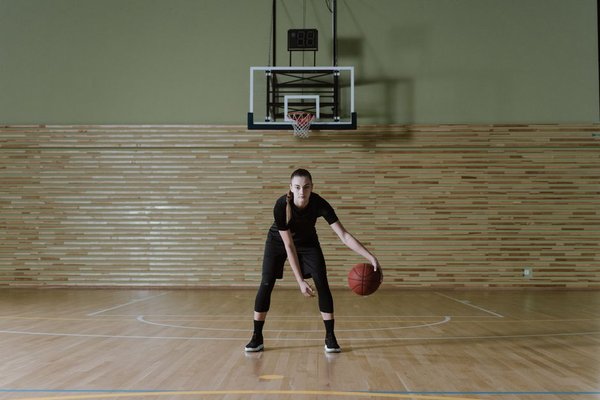
Give each child a ball and a safe area. On “green”, they dribble while moving. On “amber”, they slow down and keep the bounce controlled. On “red”, they stop, protect the ball and hold a balanced stance. Add “turn” later so they practise changing direction. At this age, success means looking comfortable with the ball, not performing a perfect crossover.
Throw, Catch and Move
Ask players to toss the ball up, catch it with two hands, then move to a new marker. Progress to a bounce before the catch or a gentle partner pass. This develops tracking and coordination. For early kids basketball training, simple tasks like these are often more useful than complicated set plays.
Ages 8-11: Connect Fundamentals to Simple Games
Cone Gates Dribble
Set up pairs of cones as “gates”. Players score a point each time they dribble through a different gate under control. Encourage both hands and changes of direction. Later, add a shadow defender who applies light pressure. The drill then progresses from technique to decision-making.
Pass and Relocate
Put three players around the perimeter. The player with the ball passes, then immediately moves to an open space. The receiver turns to face the basket before making the next pass. This teaches an important junior basketball coaching habit: do not stand still after releasing the ball.
A practical school-hall version works even when space is tight. Use half a court, place four floor markers around the key and ask players to pass, relocate to an empty marker and call a teammate’s name before receiving. It can even be run without a basket, which is useful in community venues with limited court access.
Ages 12-14: Add Pressure and Decision-Making
1v1 Closeout and Drive
Start an attacker on the wing and a defender near the basket. The defender passes out, closes the space under control and then defends live. Give the attacker a limited number of dribbles to create a shot. This develops footwork, on-ball defence and attacking decisions together.
In England, Basketball England restricts zone defence in younger competitions to support individual defensive development. Teaching players to stay balanced, contain the ball and understand player-to-player responsibility therefore fits well with the skills expected in junior basketball.
Advantage 2v1
Two attackers play against one defender and try to create a good shot without holding the ball for too long. Start each repetition from different positions. Players learn when to pass, when to drive and how to move into space. These youth basketball drills work because the best choice changes each time.
Ages 15-17: Train Skills at Game Speed
Drive, Kick and Extra Pass
Set three attackers around the perimeter. One drives, draws a help defender or marker, then passes out. The receiver either shoots if clearly open or makes the extra pass to a teammate in a better position. Run it from both sides before adding live defenders. Older players should connect technical skill with spacing, timing and reading the defence.
Transition Decision Game
Play 3v2 toward one basket. When the possession ends, quickly start a new attack in the opposite direction with an advantage. The drill develops communication, sprint habits and fast decisions without scripting every movement.
How to Progress Youth Basketball Drills Safely
Change one variable at a time. A useful sequence is technique without pressure, technique while moving, passive defence, then live competition. If accuracy collapses when pressure is added, step back briefly rather than allowing poor movement to become the habit. New activities should be introduced gradually and matched to age, ability and experience.
For a typical grassroots session, combine a movement warm-up, ball-handling, passing or finishing, small-sided games and a short free-play finish. Coaches can build related sessions around basketball dribbling drills, basketball shooting technique and basketball defence fundamentals.
Common Coaching Mistakes to Avoid
Avoid turning every drill into a race. Speed matters, but control comes first. Do not keep children in long queues or overload them with several coaching points at once. Pick one clear focus, such as keeping the head up while dribbling or landing balanced after a jump stop.
Separate effort from outcome too. A missed lay-up can still be a good repetition if the player used correct footwork and created the right angle. Praise the decision, then help with the finish. That protects confidence without lowering technical standards.
Frequently Asked Questions
The right length depends on age and experience. Younger children usually respond better to shorter blocks of varied activity, while teenagers can handle longer sessions with more tactical detail.
Regular short practice can complement club sessions well. Brief home work on dribbling, footwork or close-range shooting is useful, provided children also have rest and a healthy variety of physical activity.
Yes. Encourage dribbling, passing and finishing on both sides from an early stage. The weaker hand usually improves best through simple, frequent repetitions before heavy defensive pressure is added.
Competition can be introduced early if the task is simple and the emphasis stays on effort and learning. As players get older, add defenders, scoring conditions and game-like decisions instead of relying only on unopposed technique work.
Conclusion
The best youth basketball training develops with the player. Younger children need playful movement and ball confidence; pre-teens need strong fundamentals connected to simple decisions; teenagers need the same skills under realistic pressure. For UK parents and grassroots coaches, the aim is not to rush children into adult-style basketball. It is to create sessions where they touch the ball often, solve problems, enjoy competing and leave the court wanting to return.